In 2010, I started an SEO agency using the nickname I earned from a decade of figuring out how to outsmart the algorithms. I was proud my domain had a keyword in it too — OptimizationGuy.com.
I'd barely printed my business cards when I surveyed the battlefield. Google had just unleashed a monster with an adorable name: Panda (2011). Google names its weapons like children's toys. Panda mauled the content farms: websites pumping out thin, cheap articles by the thousand, stuffed with keywords, built for rankings instead of readers. It picked their keyword-stuffed bodies apart to the bones. The carcasses of once top-ranking websites were flung to the farthest corners of the www.
Then Penguin was released (2012). It was clever and vicious, attacking keyword manipulation (I did it gracefully, I swear) and shady link-building (Hey now! C'mon) and blog networks (Told you so).
Hummingbird swooped in next (2013). Such a cute name. That little birdie affected 90% of all searches worldwide (Search Engine Land, 2013). But this one wasn't an attack. It was a rebuild of the entire engine: Google learned to read the meaning of a search instead of matching the words in it. No carnage this time, just a quiet announcement that the old game was permanently over. The days of keyword manipulation were done. (Rest in peace. I will miss you.)
In 2015, we watched the battle of Mobilegeddon, when Google sent its army of bots to attack websites that weren't mobile friendly. Businesses all over the world were yelling, "What? Now I gotta pay for a mobile version? Get outta here!" Of course it was for the greater good. Progress! But a lot of innocent people and small businesses got hurt if they didn't have the extra money to update their websites.
Next, Google unleashed a monster named Fred (2017), who staggered into the world wide web and ripped the heads off websites with thin content specifically designed to profit off advertising revenue.
Medic (2018) — a poison pill that crippled the medical and YMYL sector if they were untrustworthy with no real authority — and many were. (Nice work, Google. Grifting off the sick and needy is one of the lowest forms of ecommerce on the internet.)
When Google released the "Helpful Content Update" (another delightfully ironic name), the battle was long (2022–2024), fierce, and ruthless, with no mercy. Google never released an exact body count, but they did report reducing unhelpful, poor-quality, and plagiarized content in search results by 45% (Google, 2024). Analysts speculated the casualties were in the millions. Wow, that's a lot of rot.
Fortunately, Google always removes the bodies it slaughters from the battlefield. I shouldn't joke. A lot of innocent civilians were killed during Google's carpet bombing.
Helpful Content was a bloodbath because it used a site-wide net of scrutiny. The algorithm had a total-site classifier that weighed the value of your content. If Google's version of Lady Justice put your website on her scale and it tipped toward "unhelpful," your website was toast. Vaporized. Deindexed and sent to a black hole somewhere in another galaxy, far, far away, never to be seen again. Good riddance, right?
However, if you were an innocent victim — even if you could prove it — no help was available. Google did not allow an appeal process. They ignored thousands of people whose independent websites were obliterated by the dragnet. Maybe they knew that trying to objectively define "useful content" was a subjective, slippery slope? My best guess is that Google categorized those people as "collateral damage" in their war against the pesky black-hat SEO opportunists. I get it, but ouch. The no-review process was cold.
Back in my safe house, I wasn't attacked — most likely because I kept my Google best-practice rules visible. They're kinda like the talismans in the creepy-but-awesome horror series From, if you know what I mean.
Why did my safe house hold? Years later, Google gave the reason a name: E-E-A-T — Experience, Expertise, Authoritativeness, Trustworthiness. It's the standard Google's own quality raters grade websites against, published right there in their guidelines.
It started as E-A-T around the Medic era. Then in 2022, Google added the first E — Experience — finally admitting that content written by someone who has actually done the thing beats content written by someone who just read about it. For an old veteran with scars, that was the first algorithm update that ever felt like a thank-you note. Every battle above punished the same sins and rewarded the same four virtues — and here's the kicker: the new AI engines are grading the exact same homework.
If you're new to SEO, go to Google Search Central and read their SEO Starter Guide. Google is good about telling you the rules. If you learn them, you should be safe from their vaporizing gun — but I can't promise you anything. No one knows what monster of an algorithm update is coming next. Keep your talisman close at hand and stay safe.
But here's what the war stories don't tell you. While Google was cleaning up the battlefield, it was also quietly shrinking it.
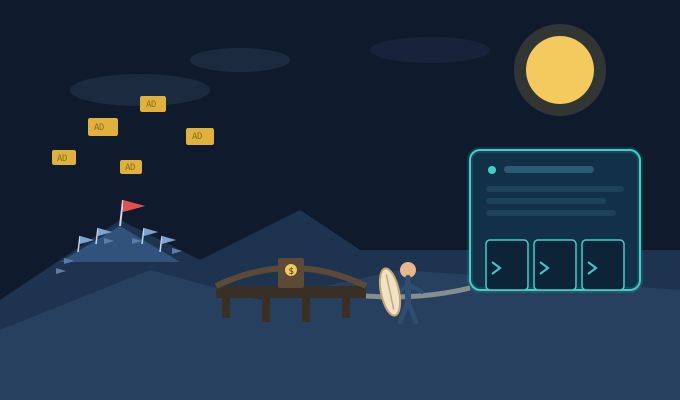
Not only does Google own the bridge — it keeps closing lanes. In the good old days, when things felt somewhat fair, you fought a good battle, climbed over your competition, and reached the top of the rankings — the ten blue links on Google page one. The clouds parted, the sun shined, and your business phone began to ring. Even at position #10 on page one, you were happy. The closer you climbed to #1, the louder it rang.
Then Google started gobbling up page one with paid ads. First they lived off to the side in their own column. Then they moved to the top and bottom, sandwiching the organic results that had actually earned their spots. Every update took a little more room, until the #1-ranked website — the one that fought for that crown — got shoved below the fold, where nobody sees you without scrolling.
Today I have businesses ranked in the top five checking to see if they forgot to switch their phones off silent mode.
But those phones aren't broken — and the customers didn't disappear. They just ask their questions somewhere new. And for the first time in twenty years, that somewhere is a door Google doesn't own.
The numbers back up what my clients feel. Roughly two-thirds of Google searches now end without a single click to any website — the searcher gets an answer on Google's page and leaves (Search Engine Land, 2026). And when Google shows one of its AI Overviews, clicks to the top organic result drop by more than half (Ahrefs, 2025). The bridge is still standing. The toll went up, and the lanes went down.
There's an old SEO joke that goes like this: Where's the best place to hide a dead body? Google, page two.
It's still kinda funny, but I have an update for 2026: Where's the best place to hide a dead body? Google, page one.
So where does an old veteran go from here? To the new frontier — through that door. When somebody asks ChatGPT, Claude, or Perplexity "who's the best plumber near me," there's no ad stack, no map pack, no three screens of distractions. There's an answer. One recommendation, maybe two or three.
The businesses that learn how to be that answer are going to eat very well in the next few years — and the line to get in is still short. That's the battle I'm training clients for now. Old rules still apply: follow the guidelines, earn the trust, do the work right. New battlefield, same talisman.
If you've read this far, congratulations. I admire your fortitude. It's clear to me that you're going to succeed, because you had the patience to read through my 1,500-word "History of SEO" summary. I hope I've been somewhat helpful with my useful content, so Lady G doesn't put me on the light end of her scale. I apologize for sprinkling in a few keywords here and there. Old SEO habits are hard to shake.
I ran this page by my favorite AI to rein me in where needed. He mostly behaved — and I'm happy to report I passed his keyword-stuffing scrutiny.
After so many years of writing webpages that rank high without getting penalized, I like to call my writing style "weaving." Keyword stuffing is for SEO cavemen. When I write a webpage, I weave keywords into the copy the way a custom tailor crafts a hand-sewn suit. That's what you get when you hire me. Could an AI learn to write like I do? Honestly, my favorite AI is picking up my style faster than I'd like to admit. My wife is rooting for the AI — she'd like me to spend less time on a computer and get her husband back. And with that, I bid you a good day. If you have any questions, drop me a line on my contact page.